
Velocity and duty arps
Velocity and duty arps modulate per-step velocity and duty cycle using short cyclic patterns: similar to how note arps and CC arps work. Each row has its own arp pattern (up to 8 values) and an independent arp length.
Three arp variants exist:
| View | What it shapes | View type | Sequencer(s) |
|---|---|---|---|
| Velocity arp | Velocity, per row | 7 | Synth seqs 1–7 and 9–12 |
| Duty arp | Note length, per row | 6 | Synth seqs 1–7 and 9–12 |
| TR-8 velocity arp | Velocity, per drum voice, main and alt kits | 19 | Seq 13 (TR-8) only |
Velocity arp step values represent output velocity (0–7 mapped to MIDI velocities). Duty arp step values represent note duty cycle (0–7 mapped to duty fractions).
What You See
The view follows the same layout as CC arps:
- LHS LP: 8 rows × 8 columns showing an overview of all rows’ arp patterns. Each lit cell represents an active arp step for that row. The currently-playing step in each row is highlighted with the position colour (white). Steps beyond the row’s arp length are unlit.
- RHS LP: step-value editor for the currently-selected row. Values run 0–7, shown as a single lit pad per step at the height of its value (bottom = 0, top = 7), not as a bar filled from the bottom. Steps beyond the row’s arp length still show their stored value, but in slate rather than in the value colour, so you can see where the list stops without counting.
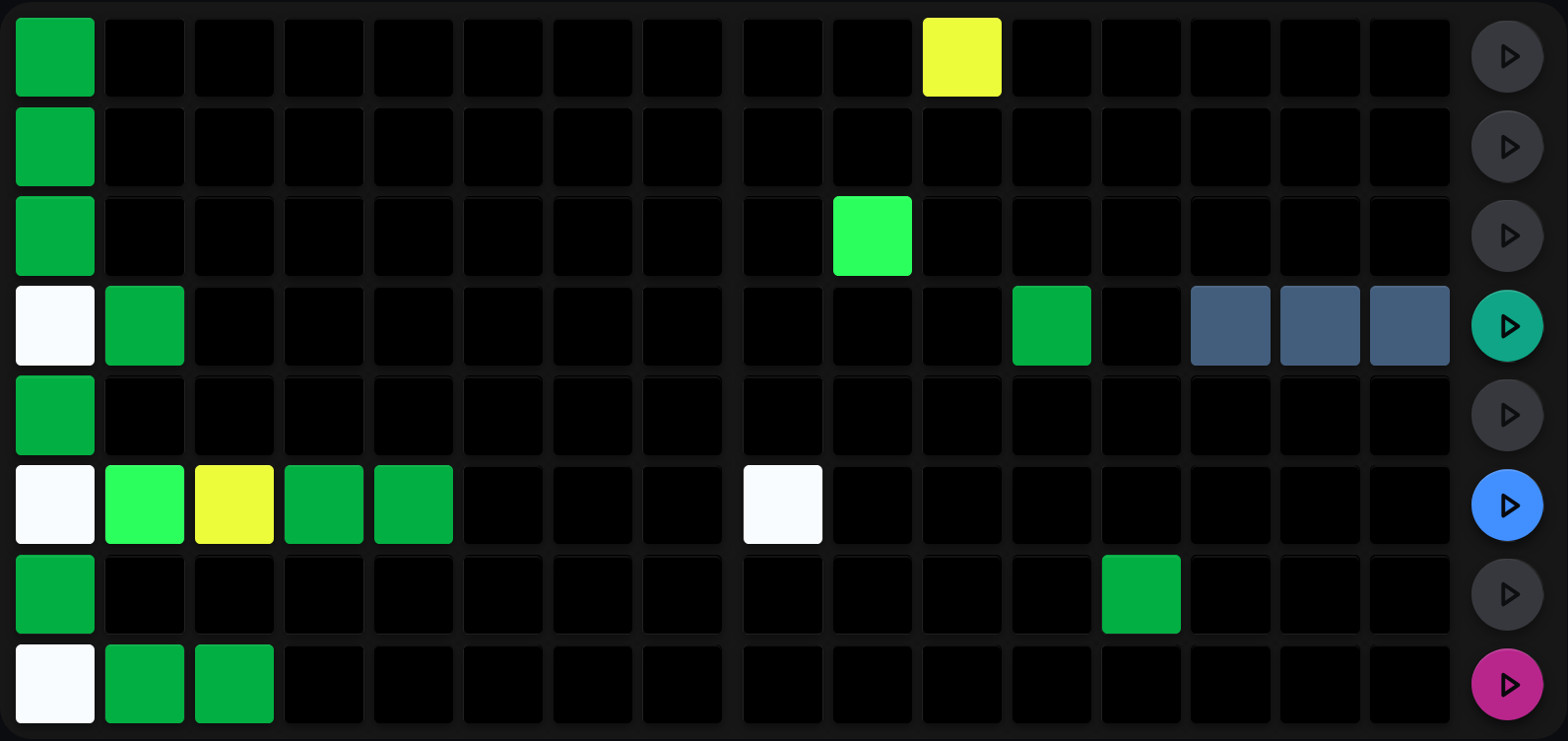
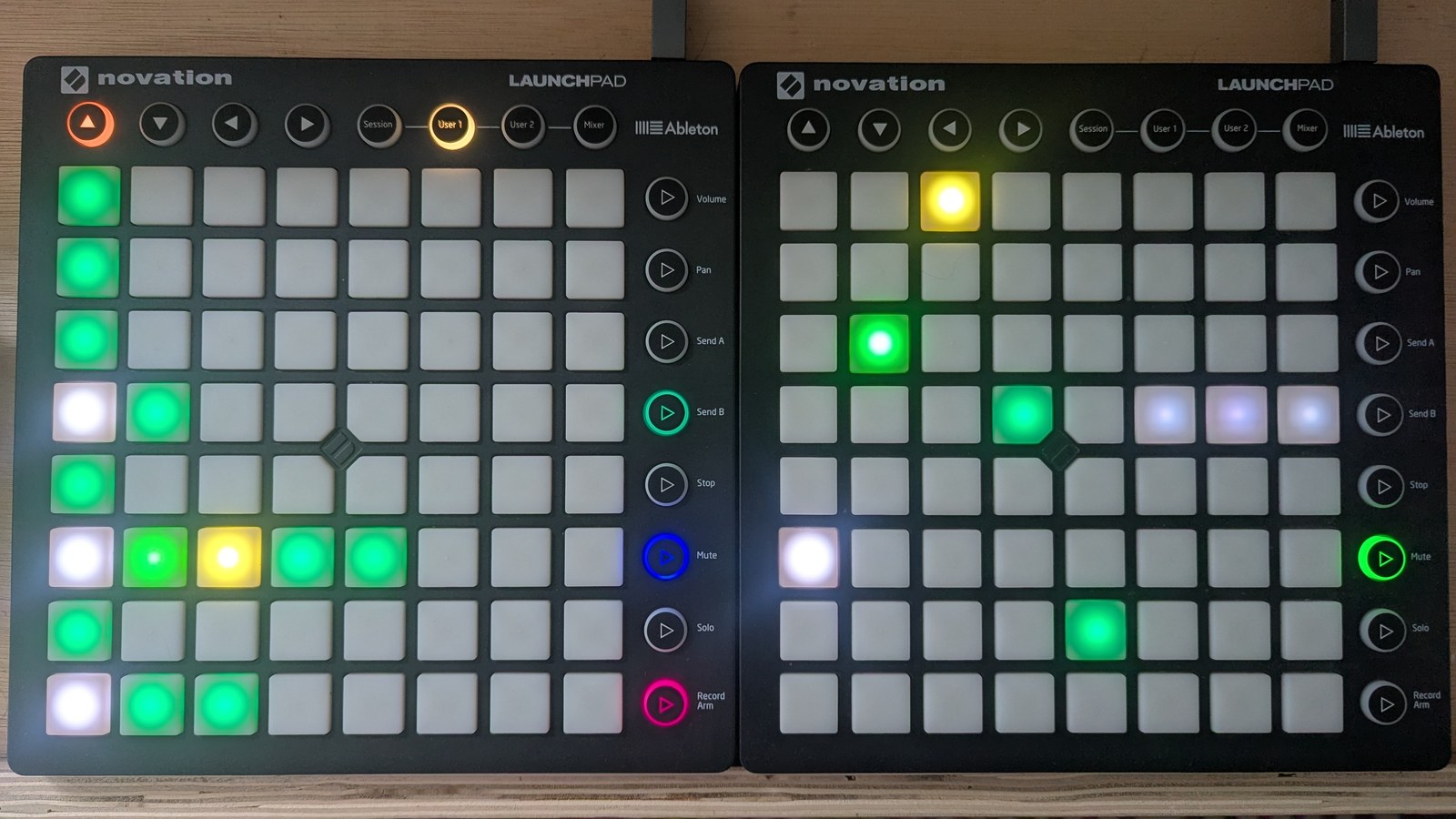
The duty arp. Same three rows as the note arp, same lengths: the LHS LP counts them, the RHS LP edits the selected row’s five values, and white marks the slot that is playing right now.
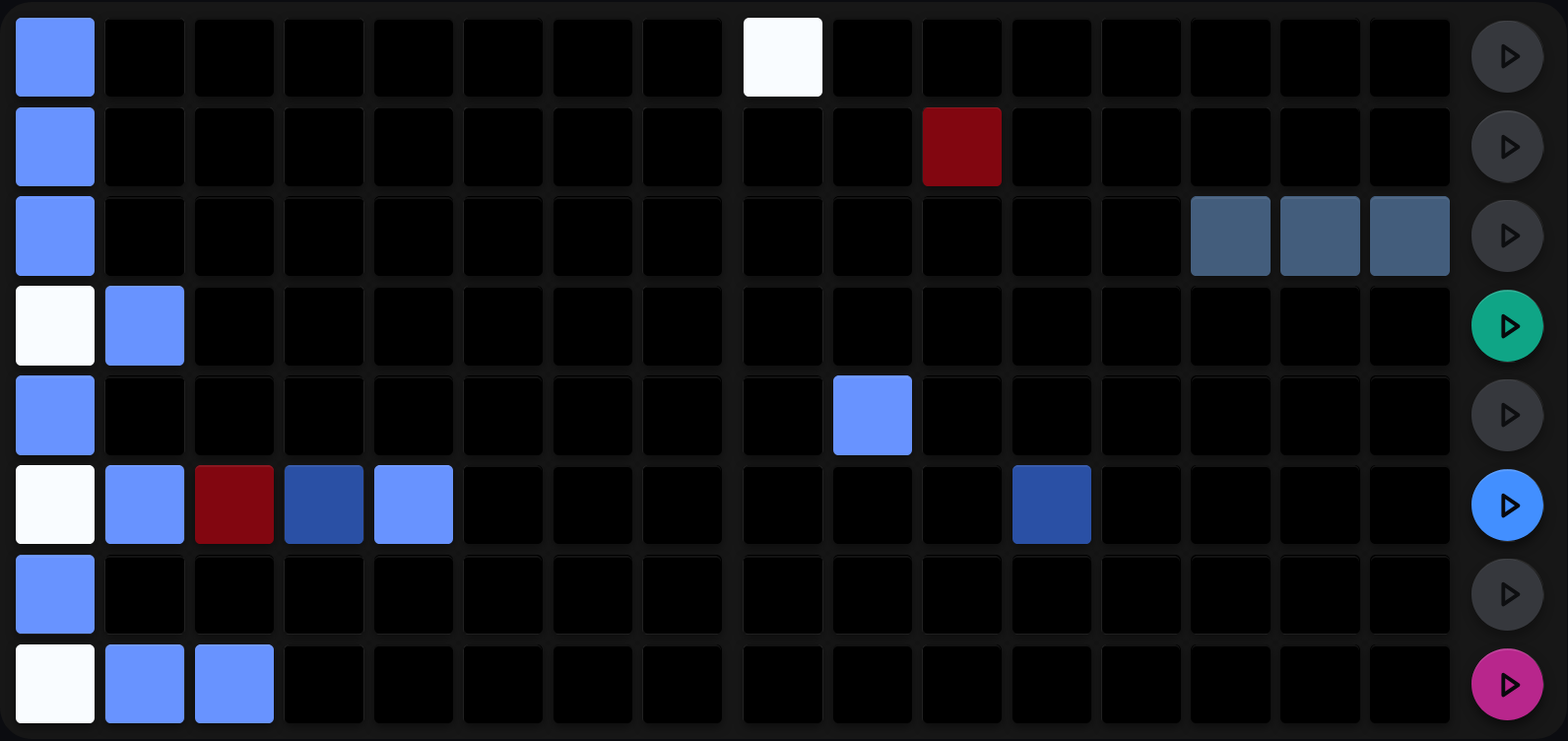
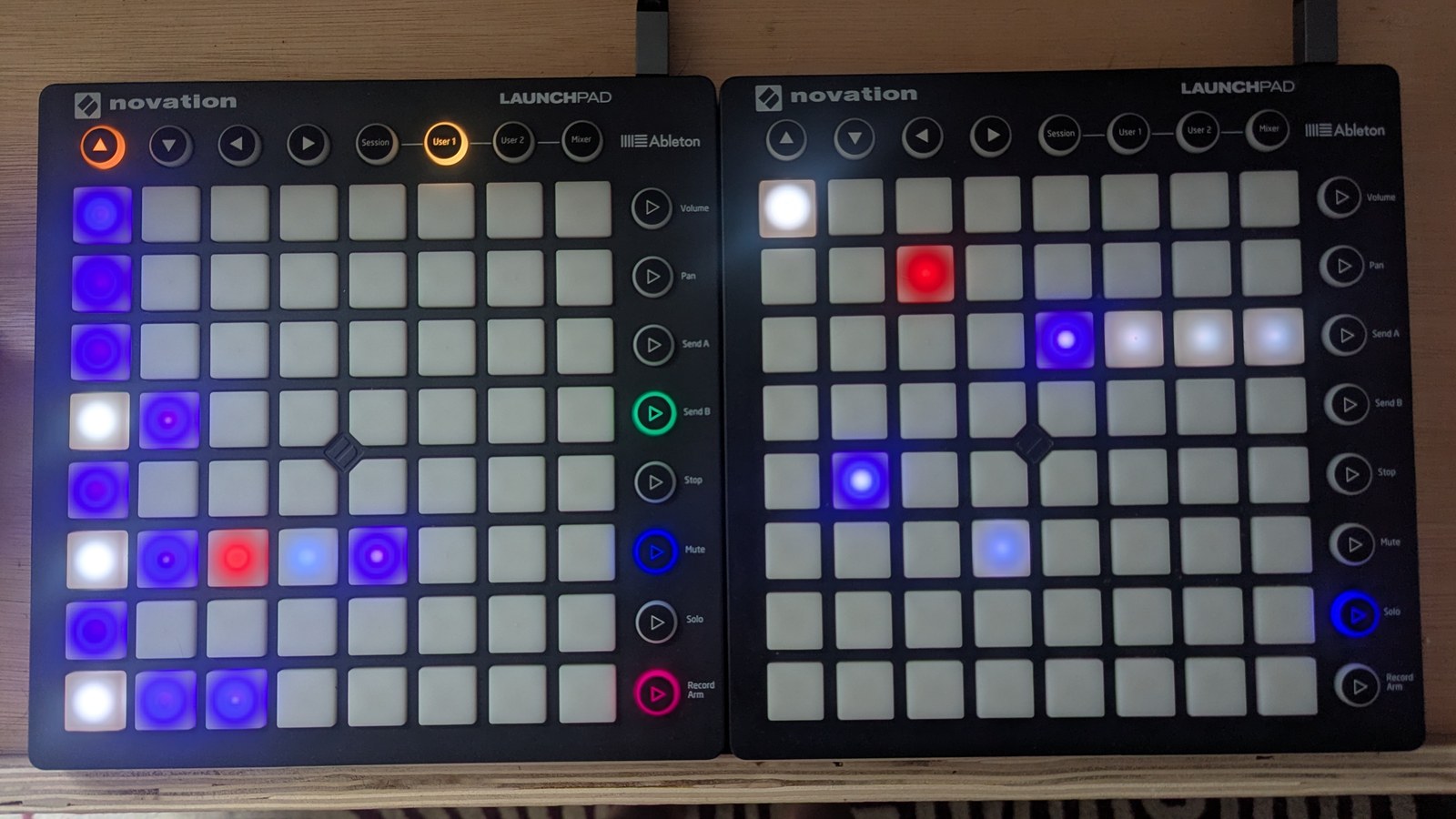
The velocity arp is the same instrument pointed at velocity, and the shared structure is the point: learn one of these views and you have learned four. Only the palette changes (blue up to red for velocity, green up to yellow for duty).
Edit Workflow
1. Select a row and set arp length (Launchpad LHS, the overview LP)
Row lengths are set on the same LP that shows the overview, so you press the row you are looking at. Press LHS row R, column 1–8:
- Any press selects row R (focus moves there; the length is unchanged).
- Double-tap (two presses within 350 ms, no LC modifier held): sets that row’s arp length to the column number. Column 1 gives a one-slot arp, column 8 gives all eight.
- Hold SHIFT and press once: the same write without the double-tap.
Column 9 selects the row and never writes a length, so it is the safe way to move focus.
The stored length is the column number minus one, and the engine wraps the position with pos > len, so a stored 0 is one slot played on every trigger rather than a bypass: there is no “off” for a velocity or duty arp. Column 1 therefore parks the row on its first slot. After a reset that slot holds the neutral value (velocity ×1.0, duty one 16th), which is why it behaves as “no arp”. But a first slot holding anything else applies to every hit on that row. Note which way each one applies: the velocity arp multiplies into the velocity you drew on the step, whilst the duty arp replaces the per-step note length outright (see Step values, which also lists the eight note lengths a duty value can pick, and Arp curves for changing them).
2. Write step values (Launchpad RHS)
With a row selected, press a pad on the RHS:
- Column (1–8) = arp step 1–8.
- Row (1 = bottom = value 0, 8 = top = value 7) = the arp value to write.
Reset and Randomise
Hold the LC modifier, then press a pad. Which pad you press decides what the gesture means, and neither gesture touches the arp length.
On the LHS LP both gestures live in column 9, the same column you use to move focus without writing a length. Columns 1–8 of the LHS ignore them entirely, so a mis-aimed press does nothing rather than something you did not want.
| Gesture | Effect |
|---|---|
| SHIFT + MUTE, press LHS col 9, row R | Reset row R’s 8 arp steps to the neutral point on the shipped curves: 5 on a velocity arp (×1.0), 4 on a duty arp (1/16, one whole step). |
| SHIFT + MUTE, press RHS row R | Reset the selected row’s 8 steps to the value of the row you pressed (bottom row = 0, top row = 7). |
| SHIFT + SOLO, press LHS col 9, any row | Randomise the selected row’s 8 steps freely across 0–7. |
| SHIFT + SOLO, press RHS row R | Randomise the selected row’s 8 steps around row R’s value, ±2, clamped 0–7. |
The two LHS gestures pick their row differently, which is worth a moment: reset acts on the row you press, so you can flatten a row you are not currently editing, whilst randomise acts on the selected row, whichever column-9 button you happen to hit. If you want to randomise a particular row, select it first.
TR-8 Velocity Arp
The TR-8 velocity arp view works identically to the synth velocity arp, but targets the tr8_velo_arp_{row} arrays (main kit) or tr8_velo_arp_{row}_alt arrays (alt kit). Selecting between main and alt is governed by the alt-view toggle on the TR-8 sequencer (sequencer 13).
Reset follows the voice rather than a single value, because the drum rows do not all want the same resting velocity: the ghost rows (the second row of a paired voice, so SD2 and BD2 on the main kit, CP2 and RS2 on the alt) go to 2, the boom-tsk row at the bottom of the main view goes to 7, and every other row goes to 5. The arp length is untouched, as on the synth views. Randomise behaves exactly as the synth velocity arp does.
Cross-References
- Note arp: Note arp view (same edit model, different array)
- CC arps: CC arp (similar double-tap length model, different data, and a few gestures of its own)
- Step values: Per-step velocity / duty editors (no arp cycling)
- Arp curves: What the 0–7 values mean, and how to change that per sequencer
- Reset and randomise: Full reset / randomise matrix across all views