
Chords and scales
The tonal centre of the whole rig. This page covers what a chord progression does to a sequence, how each chord is built from the root note and scale you pick, and which sequencers follow it at all. Writing the progression itself is on Chord progression, and the per-sequencer voicing on Voicing and modulation.
What It Does To A Sequence
Those sequencers that are set to follow the chord progression will have the notes of their sequence transposed in line with the chord progression. This allows you to imply different chords while still keeping the same rhythm and spirit of the original sequence.
For example, say you have a sequence that plays C E G F on repeat (the 1st, 3rd, 5th and 4th degrees of the scale). The rows that follow the progression will be transposed, and the rows that don’t will remain stationary. With the 1st, 3rd and 5th following and the 4th staying put, transposing to the fifth chord (G) turns that phrase into G B D F.
Same pattern, same groove, different chord. Which rows follow is set per sequencer in Chord Edit, and whether a sequencer follows at all is the CP toggle.
How Chords Are Constructed
The chord at each bar is built from the current scale’s root note and the chord degree you have selected. The chord-adjustment setting (see Root Note + Scale below) then colours it, offsetting individual rows so a chord is voiced rather than stacked straight up the scale.
Inversions reorder the notes of the chord:
- Third inversion: the third of the chord is moved to the bass
- Fifth inversion: the fifth of the chord is moved to the bass
Blue (random inversion) re-evaluates at each bar boundary: it randomly chooses a subset of the currently-active chord rows and drops each chosen note by one octave, so the voicing varies bar to bar rather than cycling through fixed positions. Green (mixed random) also re-evaluates each bar, but picks from a fixed distribution (third inversion (35%), fifth inversion (35%), or a Blue-style random-inversion voicing (30%)), and never leaves the chord in root position.
Root Note + Scale (view type 11)
The chord options view is the global tonal centre control. It sets the root note and scale (minor or major) used by every chord-following sequencer, and additionally hosts the per-sequencer CP-follow toggle.
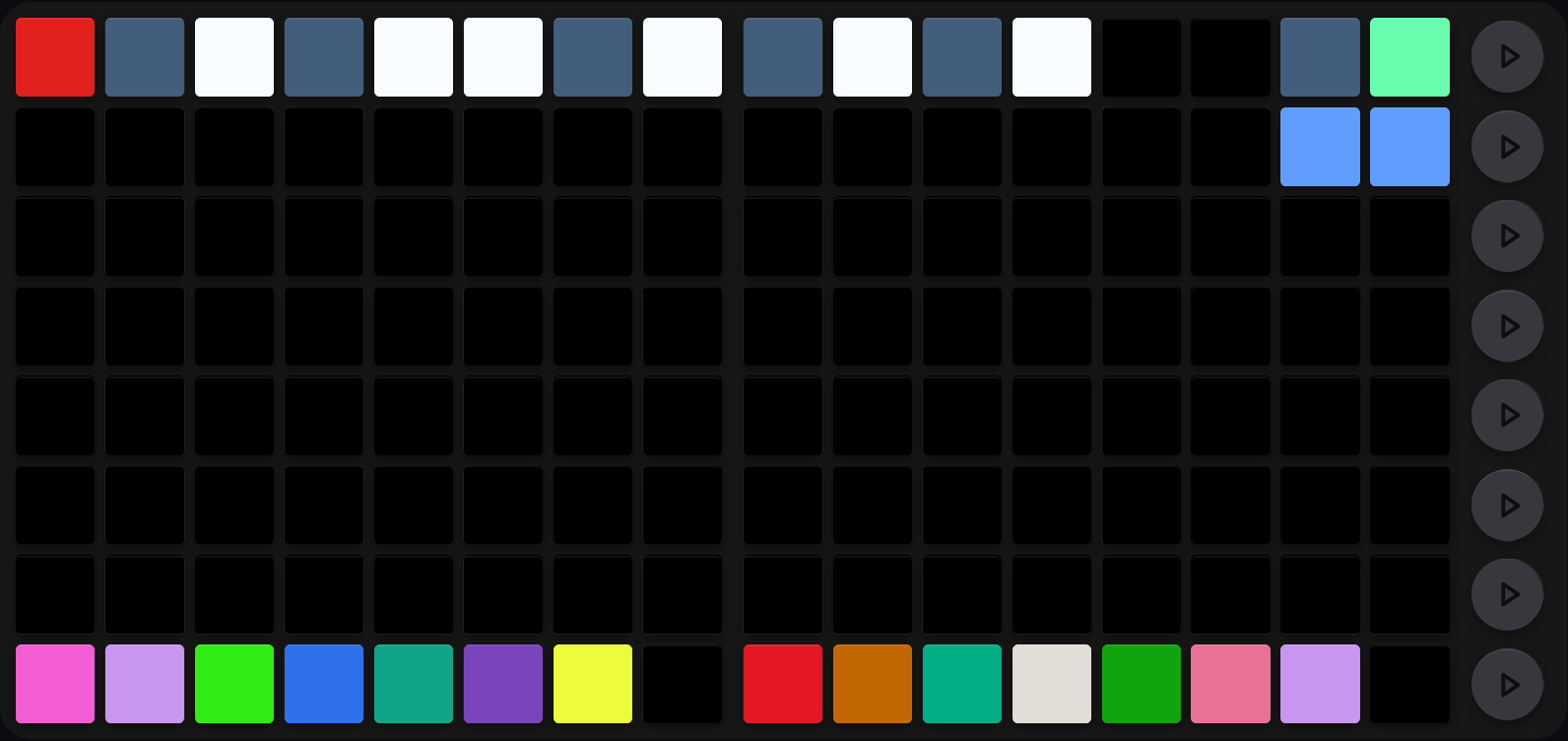
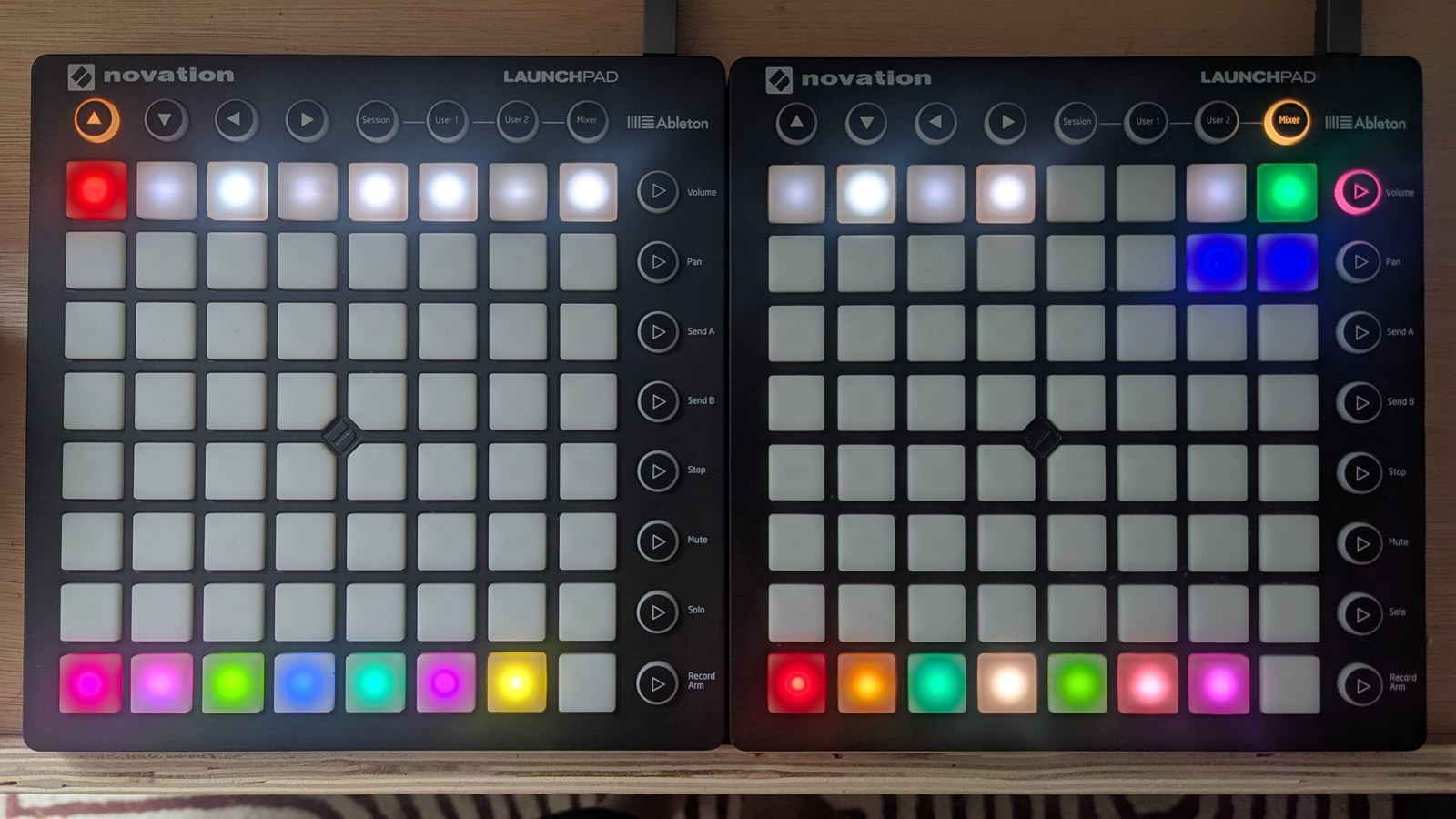
The top row is a keyboard, with white keys white and black keys slate, and the selected root lit red (C here). The bottom row is the CP-follow toggle, one pad per sequencer: lit in that sequencer’s own colour when it follows the progression, and slate when it does not, so this rig has every sequencer following. The mint-green pad at the top of the RHS LP selects minor. The two blue pads beneath it show that both the major and minor chord-adjustment selectors are in Adjusted mode.
Where it lives: View slot 0 on the meta-sequencer, shared across both players.
Chord-root strip (row 8)
12 cells across both LPs select the root note, laid out as a piano octave. LHS row 8 cols 1–8 are roots 0–7; RHS row 8 cols 1–4 are roots 8–11. The selected root is lit bright, the other white keys sit near-white and the black keys (C♯, D♯, F♯, G♯, A♯) are slate, so the strip reads as a keyboard rather than a flat row.
Scale mode (RHS rows 7–8 cols 7–8)
- Row 8 cols 7–8: major/minor select. Major lights col 7 yellow and leaves col 8 slate; minor lights col 8 mint green and leaves col 7 slate. Changing it refreshes every scale-aware view at once.
-
Row 7 cols 7–8: three-state chord-adjustment selector. Col 7 sets the mode used in major, col 8 the mode used in minor. Each press cycles through the three:
Colour Mode What you hear Dark Plain No adjustment; chords plane chromatically. Blue Adjusted Hand-tuned colouring, the default character. Purple Diatonic Exact diatonic chords, note arps harmonised to match. Diatonic mode keeps chord progressions and moving note arps strictly in scale. See Note arp for how it affects arps.
A scale-mode change immediately re-voices all chord-following sequencers; it is a global event. Adjustment-mode changes apply on the next clock tick.
CP toggle (row 1)
Row 1 holds one cell per chord-following sequencer. LHS cols 1–7 are sequencers 1–7; RHS cols 1–7 are sequencers 9–15 (sequencer 8 and sequencer 16 have no CP toggle and stay dark). Off is slate grey; on is that sequencer’s own colour. See Chord progression toggle.
Cross-References
- Chord progression: writing the progression itself, bar by bar
- Voicing and modulation: which notes of a chord each sequencer plays
- Toggle views: the CP-follow toggle, documented alongside the other toggles
- Note arp: how diatonic mode affects moving note arps