
Chord progression
The chord progression view lets you sequence which chord plays on each bar of the 16-bar cycle, and optionally apply an inversion to each chord. It is displayed on the Launchpad and shared across both players. The root note and scale those chords come from are on Chords and scales.
The Grid
The view shows a 16-column × 8-row grid:
- Columns represent bars 0–15 of the 16-bar cycle (left to right).
- Rows represent the 8 available chords of the current scale (top to bottom = chords 8 down to 1).
The lit cell in each column indicates which chord plays on that bar. The colour of the lit cell indicates which inversion is applied to that chord.
The current bar is highlighted in magenta regardless of inversion state.
Inversion colours
| Colour | Inversion |
|---|---|
| White (bright) | No inversion: root position |
| Mustard | Third inversion |
| Red | Fifth inversion |
| Blue | Random inversion: randomly drops a selection of active chord notes by one octave on each bar, producing an unpredictable chord voicing |
| Green | Mixed random: randomly picks third inversion (35%), fifth inversion (35%), or a random-inversion voicing (30%) on each bar; root position is never used |
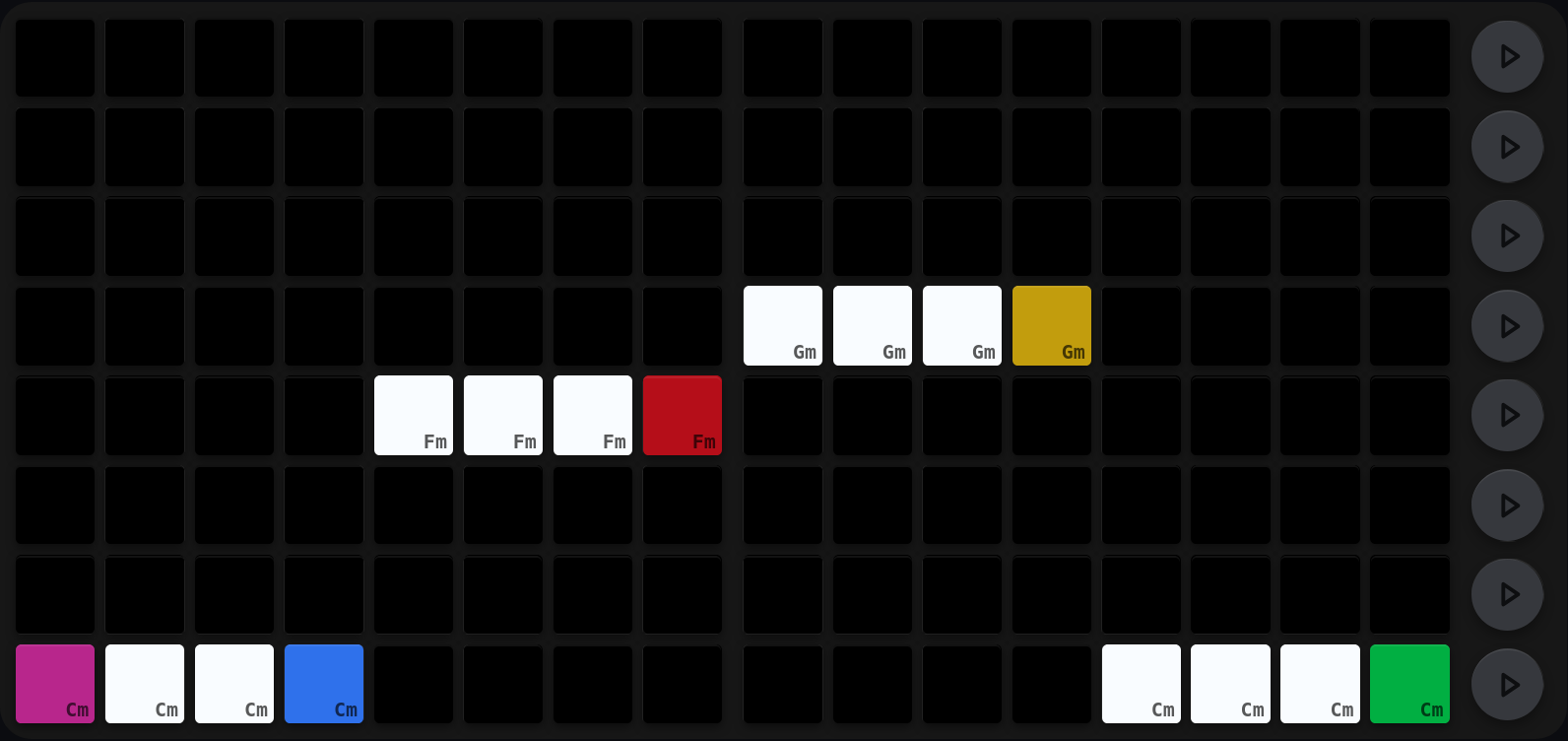
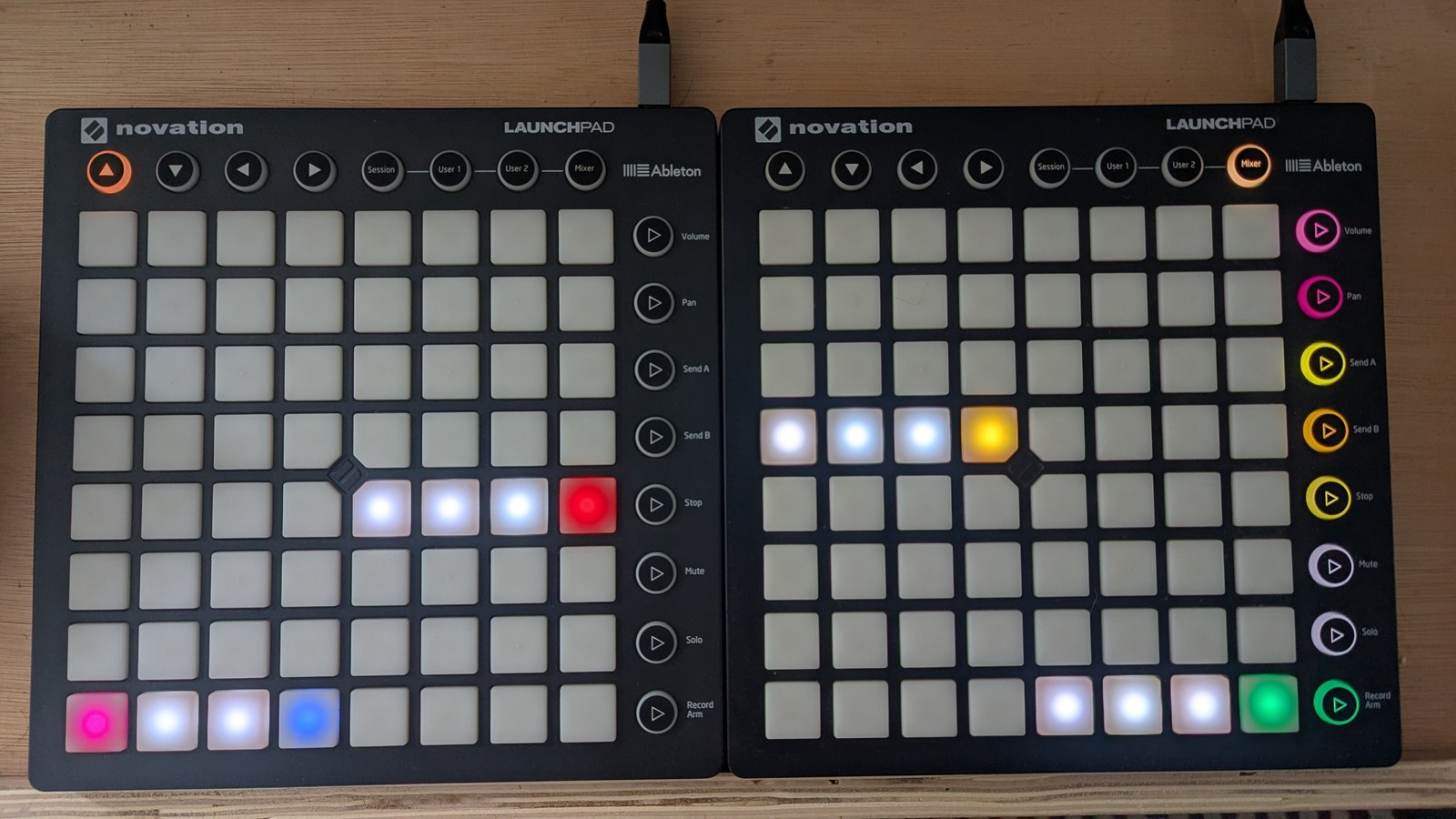
A i-iv-v-i loop, four bars to a chord. Height is the chord, and the blocks make it readable at a glance: the tonic on the bottom row, the fourth three rows up, the fifth just above that, then back down to the tonic. The last bar of each block carries an inversion, which is what the colours are for: blue closes the first tonic block, red the fourth, mustard the fifth and green the last. Everything else sits in root-position white. The pink pad at bar 1 is not an inversion, it is the bar playing right now.
Editing the Progression
Pressing a pad in the chord progression view sets the chord for that column to the row you pressed. The column immediately updates to reflect the new chord.
Pressing the pad again cycles through the inversion colours for that step: White → Mustard → Red → Blue → Green → White → …
Each player can edit the progression independently; changes take effect immediately on the shared progression.
Notes
- The chord progression is global: every sequencer that follows it reads the same chords and the same inversions.
- The highlighted column is the bar you are on, counted bar 0 (the top of the cycle) to bar 15.
- Both Launchpads (left and right) display the chord progression view simultaneously: bars 0–7 on the LHS LP, bars 8–15 on the RHS LP.
Per-Chord Clock Division (view type 25)
Each sequencer has an independent chord-progression advance rate, and the chord clock division view is where you set it. The rate decides how fast that sequencer walks through the 16-bar progression grid, independent of its note-clock division.
Where it lives: View slot 1 on the meta-sequencer. The view shows a per-sequencer rate selector on both LPs, and both LPs stay in sync.
Edit gesture: One LP press per row. The column you press sets that row’s sequencer to that rate.
| Rate | Step divisor | Chord changes |
|---|---|---|
| 1 | 128 | Every ~8 bars |
| 2 | 64 | Every 4 bars |
| 3 | 32 | Every 2 bars |
| 4 (default) | 16 | Every bar |
| 5 | 8 | Every half bar (8 steps) |
| 6 | 4 | Every quarter bar (4 steps) |
| 7 | 2 | Every 2 steps |
| 8 | 1 | Every step |
Rates 1–4 produce bar-constant chords (the chord is stable within each bar). Rates 5–8 advance the chord within a bar: useful for chord-arpeggiation effects where each step of a bar lands on a different progression slot.
Cross-References
- Chords and scales: root note, scale, and what a progression does to a sequence
- Voicing and modulation: chord edit and the per-bar chord modulator
- Trigs: the trig view, where a chord-following sequencer plays its chords
- Reset and randomise: the full reset/randomise matrix. The chord progression grid (view 12) is the only chord view that answers those gestures; chord options (11), chord edit (13) and chord clock division (25) all ignore them deliberately, being either too disruptive or a single value